

- Polytech
- BATir - Building, Architecture & Town Planning
- News
-
Share this page
Public PhD defence of Yves Bettignies on "Urban scaling laws of energy use. A multiscale and international study."
Cities are the end-users of ~71% of the global energy and are thus responsible for ~73% of CO2 emissions related to energy use. This figure will only grow as it is estimated that up to 80% of the world’s population will live in cities by 2050. Reducing the impact of energy consumption of cities is therefore crucial to mitigate climate change and it is therefore important to identify actionable drivers and subsequent policies that can reduce the energy use of cities.
Cities, despite differing histories, cultures, economies, climates and social structures, display surprising common patterns. Urban scaling laws show that many city-wide variables (recently including energy use) follow predictable, emergent regularities. A growing literature documents consistent scaling behaviours across time and space (e.g., Ortman et al., 2014; Bettencourt et al., 2020; Bettencourt & Lobo, 2016; Kennedy et al., 2015; West, 2017; Zhao et al., 2018), but studies focused specifically on energy consumption remain sparse, even though the IPCC highlights their importance (Seto et al., 2014).
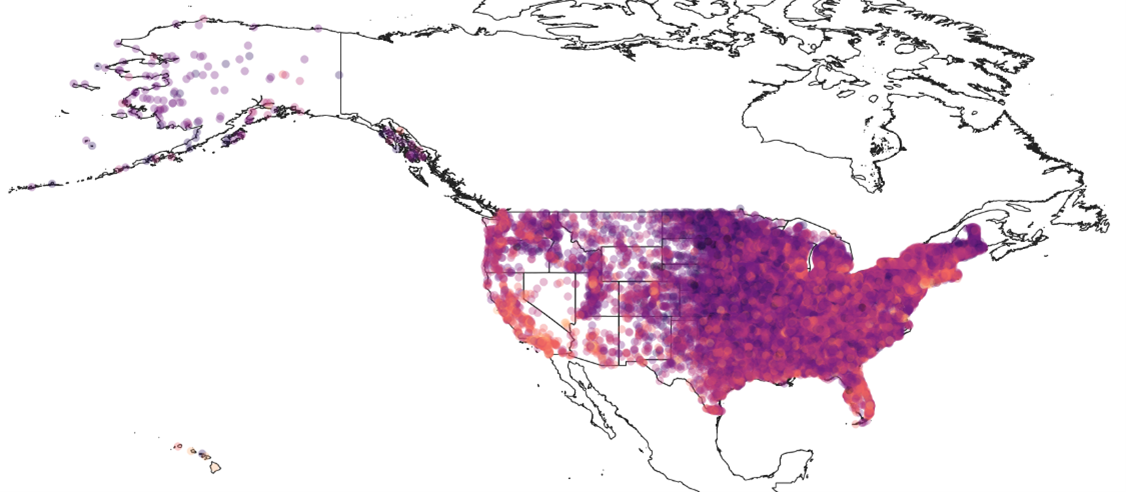
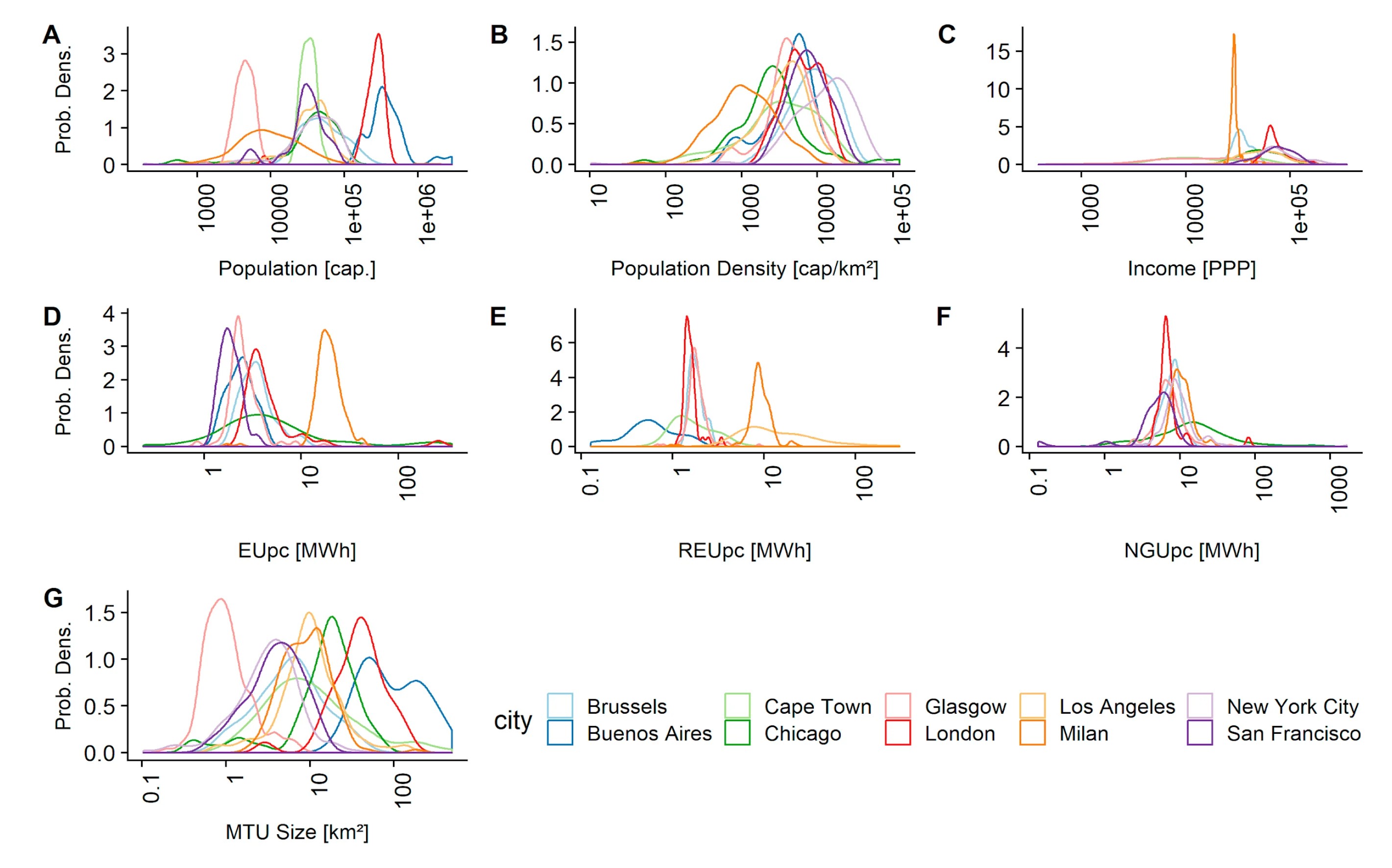
This thesis addresses that gap by analysing how energy use scales with city size in two complementary settings. First, I analyse a U.S. dataset of more than 23,000 observations to extract scaling relationships for four energy types (natural gas, electricity, gasoline, diesel) across three sectors (residential, commercial, industrial). The study finds that urban energy scaling laws exist in the U.S. and hold across settlement sizes from small towns to megacities (10^3–10^7 inhabitants); whether a relationship is superlinear or sublinear depends more on energy type than on sector, with natural gas scaling superlinearly, electricity scaling sublinearly, and total energy use scaling sublinearly. Second, I examine 10 globally distributed cities using data at both whole-city and intra-city (e.g., neighbourhood) scales to test whether internal spatial subdivisions exhibit scaling behaviour and thereby address the limits of a-spatial approaches (Carbone et al., 2021). I compare three urban attributes (population, population density, and income) against three energy-use intensity metrics and find that consistent scaling laws do not emerge when comparing these geographically diverse cities as whole units; however, within cities, infra-urban territories sometimes show correlations consistent with scaling, although the strength and form of those relationships vary by city. Overall, the findings indicate that urban energy scaling exists but is sensitive to energy type and to local city characteristics, and that intra-city analysis can reveal patterns hidden by cross-city aggregation while also highlighting strong city dependence.
at 4:00 PM
In person: Site Usquare, Building A, Blvd Géneral Jacques 210, 1050 Ixelles - OpenLab, room: A.1.23
Online: https://us06web.zoom.us/j/87088482777