

- Polytech
- BATir - Building, Architecture & Town Planning
- News
-
Share this page
Public PhD defence of Giulia Caterina Verga on "Towards Urban Circularity - Exploring and analysing circularity-inspired ambitions in Theory, Practices, and Projects"
This doctoral research critically explores the concept of Urban Circularity (UC) as a transformative lens for rethinking urban planning and design disciplines, with a specific focus on the Brussels Capital Region (BCR).


This doctoral research critically explores the concept of Urban Circularity (UC) as a transformative lens for rethinking urban planning and design disciplines, with a specific focus on the Brussels Capital Region (BCR).
Situated within the broader discourse of the Circular Economy (CE), the thesis investigates how circu-larity-inspired ambitions can be interpreted, spatialised, and operationalised across three interrelated dimensions: theory, practices, and projects. In response to escalating ecological, social, and material cri-ses, the research proposes UC as a paradigm shift toward more resource-conscious, inclusive, and less polluting urban systems. It critiques dominant technocratic, optimisation-driven, and growth-oriented narratives of CE, advocating instead for a holistic, inter-scalar, interdisciplinary, and context-sensitive approach that foregrounds sufficiency, care, and inclusivity. The thesis adopts a mixed-methods frame-work, combining literature reviews, territorial mapping, qualitative analysis of case studies, interviews and focus groups, and quantitative assessments using simplified material stock and flow analysis. This methodological approach supports both theoretical reflection and practical application.
Part 1 traces the evolution of CE from early ecological thought to contemporary policy frameworks, linking it to the broader Urban Metabolism (UM) debate. It advocates for a socially embedded and empowering interpretation of circularity, identifying three conceptual paradigms: resource efficiency, territorial metabolism, and relational ecology. A conceptual compass is proposed to help urban plan-ners and designers navigate the fragmented disciplinary landscape and engage critically with urban transformation.
Part 2 investigates Urban Circular Practices (UCPs) through case studies in the BCR, revealing how spatial constraints such as land scarcity, redevelopment pressures, and insecure tenure undermine the long-term viability of circularity-inspired initiatives. It highlights that many UCPs are challenged by competing urban agendas and the dominance of high-value land uses. The conclusions call for a re-thinking of land-use priorities and planning instruments to support empowering, spatially anchored circular practices capable of scaling and enduring within dense urban contexts.
Part 3 analyses Strategic Urban Projects (SUPs) through the lens of circularity, focusing on three major regional masterplans. While circularity-inspired ambitions are increasingly present in policy and plan-ning discourse, their integration into urban design remains fragmented and often obstructed by con-ceptual ambiguity, regulatory inconsistencies, supply chain rigidity, and spatial limitations. To address these challenges, the section introduces a preliminary Urban Circularity Design Framework (UCDF), structured around four actions: Define, Research, Anticipate, and Co-create. Specifically tailored for urban designers, planners, and practitioners, the framework offers hands-on tools for scenario-making, simplified material flow analysis, and inclusive stakeholder engagement.
In conclusion, the thesis argues that UC should not be treated as a fixed model, but rather as a dynam-ic and critical lens for re-imagining urban futures. It calls for a shift from fragmented, technocratic approaches to integrated, place-based strategies that foreground ecological limits, social equity, and long-term stewardship. At its core, UC invites planners and designers to critically question the very necessity of certain urban transformations, challenging the foundational rationale behind projects and advocating for more reflective, adaptive, and resource-conscious approaches to change. The research contributes to academic discourse, policy development, and professional practice by offering concep-tual clarity, empirical insights, and operational tools to support the transition toward more circular urbanism, especially through the design and implementation of urban projects.
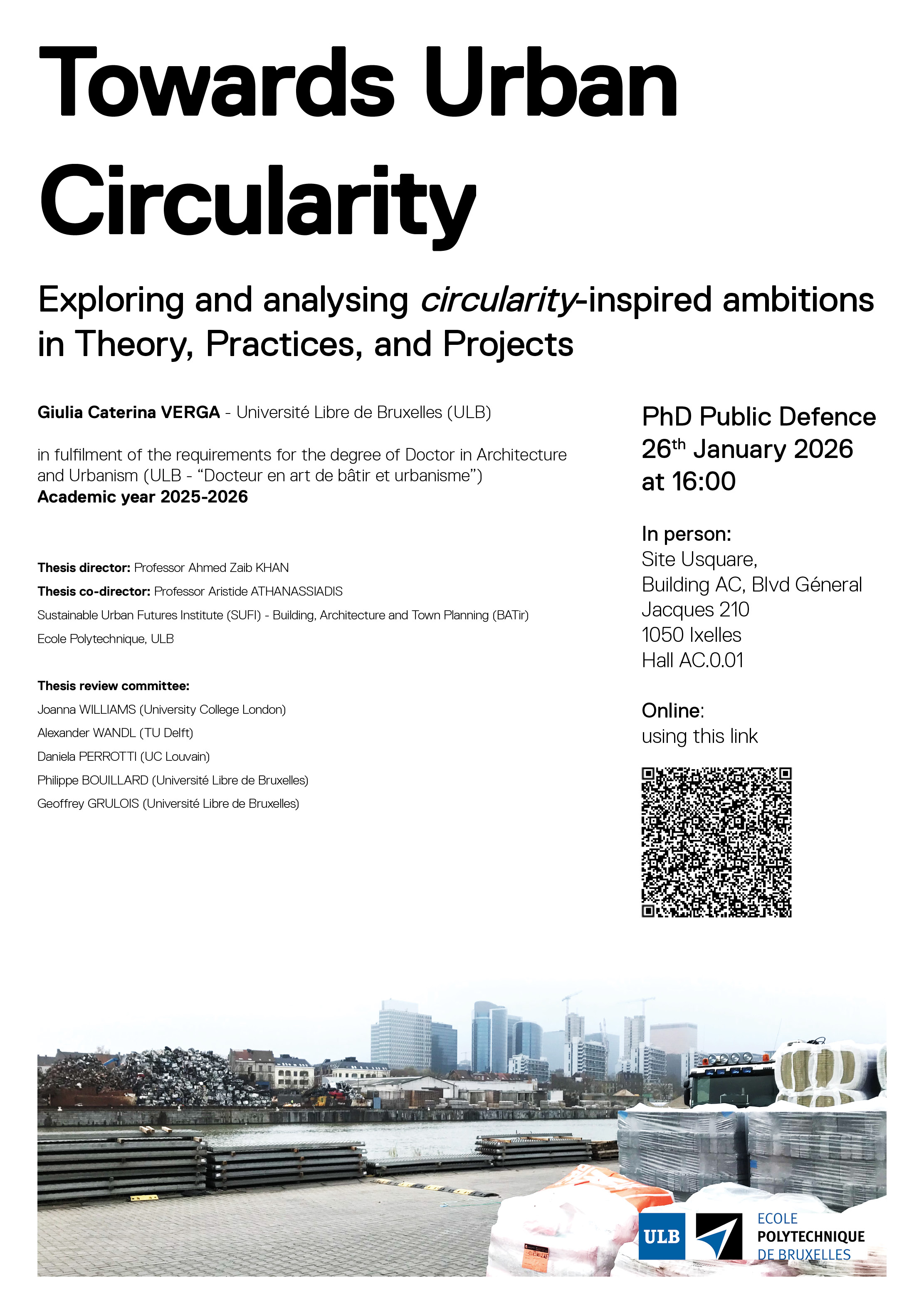
at 4:00 PM
In person: Site Usquare, Building AC, Blvd Géneral Jacques 210, 1050 Ixelles - Hall AC.0.01
Online: https://msteams.link/TGUP